Looking for Champagne? We’ve got you covered. This guide gives a clear, friendly overview of the rules and steps needed to move luxury sparkling wine to one of Africa’s fastest-growing markets. The market shows real demand: Nigerians spent about €480 million on alcohol in 2016, and total beverage volume reached 208.9 million cases by 2020.
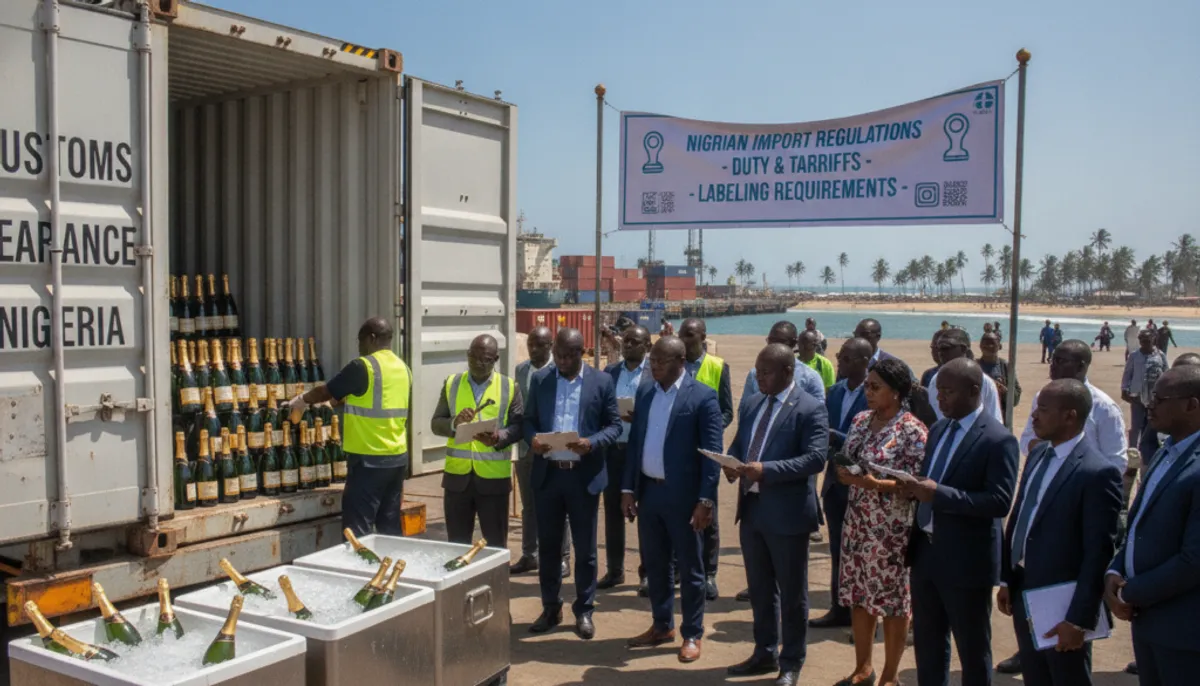
Understanding customs duties, labelling rules, and local paperwork reduces delays and legal risks. Our team at https://champagne-export.com helps brands in the United States plan compliant shipments and smooth market entry.
We guide you through tariffs, documentation, and quality checks so your premium bottles arrive ready for retailers and corporate clients. Request your personalized quote today on https://champagne-export.com to start exporting with confidence.
Key Takeaways
- Strong local demand and growing consumption create opportunities for premium brands.
- Clear compliance with duties and labelling prevents costly delays.
- Specialist support simplifies export logistics from the United States.
- Early planning speeds customs clearance and market launch.
- Request a tailored quote to match product needs and regulatory requirements.
Understanding the Nigerian Champagne Market
A growing cohort of affluent Nigerian consumers is reshaping the country’s wine market. Urban buyers favor premium wines for events, corporate gifts, and private dining. This trend creates clear opportunities for exporters and local distribution partners.
Market Growth Trends
Spending on alcohol reached about €480 million in 2016, with 75% of that concentrated in the south. Total beverage consumption rose to 208.9 million cases by 2020. These figures show steady demand for luxury products and higher-end wine labels.
Consumer Demographics
Affluent professionals and corporate clients drive premium purchases. Price sensitivity varies: some buyers seek prestige, others seek value. Proper product positioning and smart distribution increase market share.
Quick points to remember:
- Demand links closely to urban lifestyles and events.
- Position your brand for corporate and hospitality channels.
- Understanding price and packaging matters for retail success.
| Metric | 2016 | 2020 | Regional Split |
|---|---|---|---|
| Total alcohol spend | €480M | — | 75% south |
| Volume (cases) | — | 208.9M | Urban-focused |
| Primary buyers | Affluent consumers | Corporate & retail | Southern metros |
Looking for Champagne? We’ve got you covered. Discover the finest selections, ready to be exported anywhere in the world. Request your personalized quote today on https://champagne-export.com.
Regulatory Requirements for Importing Champagne into Nigeria
Before you ship premium wines, you must meet specific regulatory checks that protect consumers and merchants.
The Nigeria Customs Service collects customs duties on champagne and duties on all wine and alcohol shipments and enforces strict customs checks. You must declare accurate values and provide clear documentation to avoid delays or fines.
NAFDAC requires registration of every imported food or beverage product before legal sale. This step includes paperwork and, in many cases, lab testing to confirm safety and labeling compliance.
Navigating these regulations early saves time and money. Our team at https://champagne-export.com helps manage export documents and customs procedures so your wines clear quickly and reach distributors on schedule.
- Plan for duty calculation and customs inspections with the nigeria customs service.
- Register products with NAFDAC before local sale to avoid seizures.
- Use professional support to meet all legal requirements for smooth export and local distribution.
Looking for Champagne? We’ve got you covered. Discover the finest selections, ready to be exported anywhere in the world. Request your personalized quote today on https://champagne-export.com.
Navigating NAFDAC Registration Procedures
Before you ship premium wines, the national agency requires formal product checks and documented proof.
Documentation Requirements
The National Agency for Food and Drug Administration and Control (NAFDAC) enforces registration for all alcoholic beverages. You must submit detailed product files, a certificate of manufacture, and a responsible person’s contact. Proper paperwork speeds approval and protects distribution rights.
Laboratory Testing
The registration process involves laboratory analysis. The agency typically requests 15 product samples for testing to confirm safety and quality. These tests ensure that wines meet the food drug administration standards set under the GON Act No 19 of 1993.
Consultant Services
Engaging a professional consultant reduces common errors. Our experts at https://champagne-export.com help prepare files, arrange testing, and manage renewals. Registration is valid for five years, and proactive management keeps your brand compliant.

| Step | Requirement | Typical Time | Notes |
|---|---|---|---|
| Application | Product dossier & certificate | 2–4 weeks | Complete files shorten review |
| Samples | 15 product samples | 3–6 weeks | Laboratory testing for safety |
| Approval | NAFDAC registration certificate | 4–12 weeks | Valid for five years |
| Renewal | Updated documents | 2–6 weeks | Start renewals early to avoid gaps |
Essential Labelling and Packaging Standards
Accurate product information on each bottle prevents hold-ups during the national agency review.
NAFDAC rules require that every wine label clearly shows the percentage of absolute alcohol by volume. Additionally, it is essential to adhere to turkey alcohol labeling laws, as labels must also display the production batch number, date of manufacture, and a best-before date set at no less than half the total shelf life.
The registration process involves scrutiny by the national agency food and the food drug administration framework. The drug administration control checks label accuracy and packaging safety during nafdac registration.
- Follow the regulations set by the national agency and meet all labeling requirements for product safety.
- Include 18+ age warnings and ensure the name product protects geographical indications.
- Use food-grade packaging materials; the agency inspects materials during the registration process.
Looking for Champagne? We’ve got you covered. Discover the finest selections, ready to be exported anywhere in the world. Request your personalized quote today on https://champagne-export.com. Registered nafdac support and label checks are available to help your products clear review quickly.
Managing Customs Duties and Import Levies
Customs duties and local levies can push landed costs higher than expected if you miss a single tax line. Exporters must plan early to protect pricing and demand, especially considering the impact of netherlands wine imports. Below we outline the core fees and practical steps for US-based brands shipping wine to the Nigerian market.
Understanding Tax Calculations
The main charges applied to wine shipments are a 20% import duty, a 50% import levy, 20% excise tax and 7.5% VAT. Add these to the CIF value and freight to get the taxable base. Understanding champagne taxation in hong kong is essential for accurate cost calculations.
- Calculate total importation cost: include the 20% import duty and the 50% levy when pricing your product.
- Use current exchange rate: we help convert costs so your retail price stays competitive in local currency.
- Work with the nigeria customs service: accurate paperwork improves chances to meet the 48-hour cargo delivery goal.
- Manage certificates and payments: correct registration and timely tax settlement protect profit margins.
| Fee | Rate | Impact |
|---|---|---|
| Import duty | 20% | Applied to CIF value |
| Import levy | 50% | Large uplift to landed price |
| Excise tax + VAT | 20% excise; 7.5% VAT | Added after duty and levy |
Looking for Champagne? We’ve got you covered. Discover the finest selections, ready to be exported anywhere in the world. Request your personalized quote today on https://champagne-export.com for a detailed breakdown of duties and levies specific to your shipment.
Trademark Protection and Legal Agreements
Registering a trademark early secures exclusive rights and avoids costly disputes down the road.
The Trademarks Act of 1965 grants the holder exclusive use of a mark for specified products. Formal registration gives your brand a legal foundation and a registration certificate you can enforce in court.
A notarized Power of Attorney is required to allow a local distributor to act as your authorized person for filings. This step ensures the local distributor can file on your behalf and manage the registration process.
Use a clear distribution agreement that runs between 2 and 5 years. Include an exit clause so you keep control of the brand if you change partners.
- Protecting your brand through formal trademark registration is required before you can legally bring any wine to market.
- We help prepare the POA so your appointed person can secure rights for your products.
- Draft agreements that cover transfer of rights, quality of the product, and handling of food and beverage labels.
Looking for Champagne? We’ve got you covered. Discover the finest selections, ready to be exported anywhere in the world. Request your personalized quote today on https://champagne-export.com.
Selecting Reliable Logistics and Shipping Partners
Choosing the right carrier and customs partner determines whether your shipment arrives fast and intact.
Air Freight vs Sea Freight
Air freight is the fastest option, typically 5–10 days. Use it for small, high-value loads or urgent distribution needs.
Sea freight is more economical for large volumes. It lowers per-bottle cost but takes longer and needs careful scheduling.
Working with Clearing Agents
Licensed clearing agents speed the customs clearing process and reduce delays at the port. They handle paperwork, liaison with the customs service, and manage duty payments, including alcohol import duties.
Choose agents experienced with alcohol export from the united states and local distribution channels.
- Match freight mode to your shipment size and urgency.
- Work with agents who know the customs process and local compliance.
- Keep a reliable logistics partner to protect your supply chain and sales.
| Service | Typical Time | Best for |
|---|---|---|
| Air freight | 5–10 days | Urgent, small loads |
| Sea freight | 3–6 weeks | Large volume, cost-sensitive |
| Clearing agent | Varies by port | Customs clearing, documentation |
Looking for Champagne? We’ve got you covered. Discover the finest selections, ready to be exported anywhere in the world. Request your personalized quote today on https://champagne-export.com.
Sourcing Premium Champagne for Export
Start with trusted producers in the United States to secure consistent quality and proper certificates. This approach makes the export process smoother and protects your brand reputation.
Build supplier relationships that understand international food and beverage paperwork. A clear registration path and ready certificates shorten the registration process with NAFDAC and nigeria customs.
- Source small quantities first to test demand and refine distribution.
- Choose suppliers who can provide export certificates and product documentation.
- Plan for the registration process and meet packaging requirements early.
| Need | Why it matters | Action |
|---|---|---|
| Product traceability | Protects brand and meets regulations | Obtain certificates from supplier |
| NAFDAC registration | Required for legal sale | Submit dossier and samples |
| Customs & duties | Affects landed cost | Work with clearing agent and track exchange rate |
| Distribution test | Validates consumption patterns | Start with small quantities, grow over years |
Looking for Champagne? We’ve got you covered. Discover the finest selections, ready for export. Request your personalized quote today on https://champagne-export.com.
Conclusion
Final checks and clear processes shorten clearance time and protect your brand reputation. Work with trusted partners and build a compliant pathway that matches local rules set by the national agency.
Complete and accurate labelling, prompt fees, and good paperwork keep shipments moving. Respect the drug administration control and the agency food drug frameworks to avoid holds.
Partnering with experts lets you navigate food drug administration steps and customs with confidence. Our team at https://champagne-export.com helps you build a profitable, compliant export plan.
Looking for Champagne? We’ve got you covered. Discover the finest selections, ready to be exported anywhere in the world. Request your personalized quote today on https://champagne-export.com.